















Like many teenagers, Myess Hammouri started watching “Stranger Things” when it debuted in 2016. Like the main characters in the series, she is now a senior and ready to move on to the next stage of her life.
With mixed emotions about the finale of the award-winning show “Stranger Things,’’ I can’t help but feel sentimental about the show’s ending as I reminisce about my childhood.
Being only three years younger than the main cast, the show proved incredibly relatable. Seeing other young kids like me who are interested in nerdy activities, and experiencing sadly common things like bullying, made the show most engaging to me during Season 1. This season started the show with a strong foundation of the major themes and foreshadowing to watch out for.
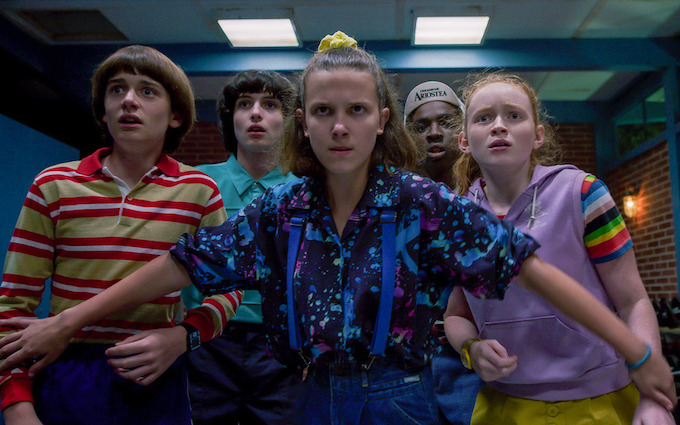
In Season 1, a main character, Eleven, mysteriously appears to the rest of the cast immediately after another child’s disappearance. The other children quickly realize that Eleven, El for short, might be linked to Will, another main character, and the cause of his disappearance. The show takes place in a fictional town, Hawkins, Indiana. The vision that residents had of Hawkins being a safe and loving town quickly begins to crumble.
El was taken in by one of the young boys, Michael, known as Mike, and was hidden in his bedroom from his family. From the moment she was found, the unexpected truth about the world unraveled as the cast of children, teenagers, young adults and parents built bonds to uncover the secrets that forever changed their perceptions.
During Season 2, El was taken in by Hopper, another main character and father figure to her. Here, she had just started to adjust to Hawkins and friends slowly became family. However, above finding and meeting others, El yearned to find herself and who she was underneath the persona built by Hawkins, marking a rebellious phase.
This rebellious phase represents a time that most pre-teens experience as they emerge into their teenage years. For El, finding herself and learning about the secrets that had been kept away from her throughout her childhood gave her clarity on her true identity. By the end of the season, she realizes that the “true” home she was searching for was nowhere to be found and it was in her new community in Hawkins all along.
I believe that she never got the chance to experience life and discover herself, so the person she became in Hawkins was her real identity. El’s character development has always been a major part of the plot because of how she was able to find her place in the world after a harsh upbringing.
By far, my favorite season is Season 3, which captured the essence of being a teen-ager while maintaining the supernatural side of the story. Even though I was only 11 years old at the time, it made me feel excited to experience “teenager things” like shopping, making friends, building connections, and fighting evil Russians.
Maxine, another main character, becomes the only other girl in the friend group of the young characters. She moved from California to Hawkins with her parents and step-brother Billy, who later becomes a core figure in the show. El doesn’t meet Maxine, also known as Max, until the end of Season 2. At first, El hated Max for her close friendship with Mike, El’s crush and best friend. The jealousy left a lasting impression of Max on El, and she refused to get close with her until the following season.
In Season 3 they bond over their troubles with their boyfriends and become inseparable. Seeing them overcome this conflict and become best friends made the story memorable to me. I’ll never forget the scene where El and Max go shopping and refuse to hang out with their boyfriends. To me, it was a strong symbolization of sisterhood and the importance of female friendships. I enjoyed seeing the show bringing the female characters together instead of pitting them against each other in a competition, as many shows do. For young girls, it’s important to build strong bonds with other girls and for shows to depict this.
Similarly, brotherhood among the main male cast was also heartwarming to watch. Seeing Lucas, Mike, Dustin, and Will’s tight-knit friendship develop over the seasons brought many ups and downs. Despite that, it was nice to see other bonds being built, like Dustin and Steve. For Dustin, Steve was an older brother figure who helped him overcome his challenges with girls, friends, and Demodogs.
Season 4, another great season, encapsulates how childhood friendships drift apart and grow distant. Even though Dustin, Mike, and Lucas were still friends, it shows a real aspect of high school where teenagers struggle to attain popularity. Seeing Lucas have to choose between his basketball teammates for popularity and his childhood friends for loyalty was nerve-wracking.
Max’s depression and loss of interest in maintaining those bonds was relatable to me and it made me feel empathetic toward her behavior, which no one else seemed to understand. Although she was going through hard times, she still cooperated with her old friends to defeat Vecna, which showed her resilience and made me take a special liking to her character. Her reliance on music to support her through tough times was not only an essential key to the plot, but it was a familiar feeling that hit close to home. Many people found her to be annoying in Season 4, but I think she was just misunderstood.
Similarly, El was also misjudged and misunderstood by her classmates in California. Although she wasn’t facing depression, being placed in a high school environment that she was never exposed to broke my heart. Seeing her get bullied was tragic because she was naive to the concept of it and everyone in Hawkins used to be understanding of her background, so everything felt very foreign to her. When bullies made fun of El for calling Hopper her hero, it evoked anger in me because Hopper became a father and inspiration to her. Her background stunted her growth in many ways mentally, so it was difficult to watch her try to process her emotions and release them in a way that seemed “cringe worthy.”
On the flip side, one of my favorite aspects of the show is how each season has its own “theme song” that represents the year of the season. Getting exposed to 80s music was one of the many ways that the show used the 80s as an important part of the plot. The show used 80s clothing, music, and scenery like the malls and festivals.
It also used the 80s to represent accurate moments of history, like when Billy was racist to Lucas and told Max to stay away from “people like him” on multiple occasions. The Cold War was another real-world issue that mirrors the 80s.
The conflict between the main cast and the Russians throughout the seasons directly mimics the Cold War during the 80s and the same fear Americans had. Although these scenes were entertaining and fun to watch, they undeniably reflect the history of the 80s. For me, being educated on racism and the Cold War made the show significantly more interesting to watch because it makes the era much more realistic. Even though we use shows to escape reality, a show that reflects 80s culture and society would be flawed without prominent issues like racism and war that existed at the time.
Season 5 disappointed me, mainly because of the ending. I hate the ambiguity about El’s future and what actually happened. Although it was heavily implied that Mike’s interpretation was correct, it just left me with mixed emotions. I’m devastated that Hawkins returned to what it was before El came into the picture, as if nothing ever happened. I also wished to see El and Mike end up together because the development of their relationship was stressed for a significant portion of the plot.
I love that Max and Lucas remained together because I’ve been rooting for their relationship since she joined the cast, especially after all of the events in Season 4. Lucas’ love for Max was unlike any other relationship in the show, and they were definitely the best couple in the entire show.
I enjoyed seeing Nancy break away from Jonathan and Steve, and venture off into her own path. I wanted to see her with Steve, but I knew they were just too different and it was already suggested that they wouldn’t end up together. Nancy and Jonathan had too many problems and differences in Season 4 as well, and I think that Nancy’s character was best suited to be independent in order to be the best version of her.
The ending of the show is symbolic for me, representing new beginnings and a stage of adulthood. Moving from the things I loved and grew up with as a child, to a memory of childhood and watching the cast age with me. The show’s impact left a dent on my expectations for other shows and their ability to trigger the same nostalgia that I may never experience again.