







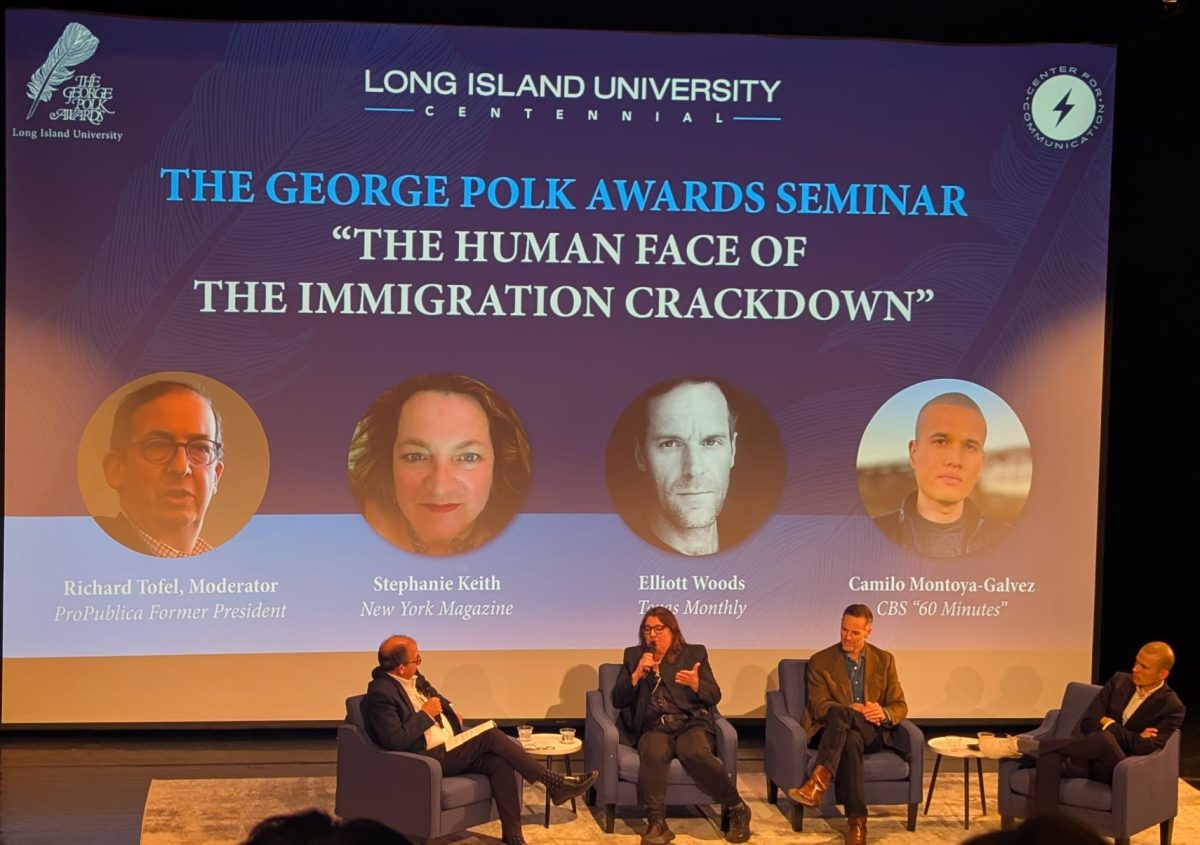
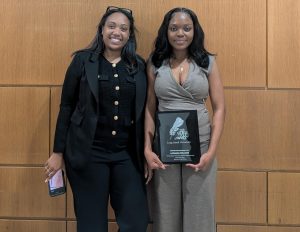
At Long Island University’s George Polk Awards Seminar, journalists came together to discuss immigration reporting, storytelling and the responsibilities that come with investigative journalism. The event on April 9 also recognized student journalists, including BRHS’s Lathania Williams, for their work covering immigration, ICE and related issues in their communities.
The panel included Elliott Woods of Texas Monthly, Stephanie Keith of New York Magazine and Camilo Montoya-Galvez of CBS “60 Minutes” with Richard Tofel, former ProPublica president, serving as moderator.
Elliott Woods spoke about how his major immigration story came to him in an unexpected way through an editor he had worked with before. As a freelancer, he explained he usually has to search for stories on his own, so this experience stood out.
“This was one of those very rare instances where the story came to me,” Woods said.
He described how his reporting focused on the 2022 South Texas migrant tragedy, but he wanted to go deeper than just the event itself. Instead, he focused on the lives of the people involved, what led them to that moment and what happened to their families afterward. To do this, he used documents, mapping and traveled across different countries to gather information.
Stephanie Keith highlighted the role of photography in journalism and how images help people better understand difficult stories. She noted that strong visuals can make stories feel more real and personal to the audience.
“Those are my archives,” she said. “I’ve become more protective of my photos and of my copyright.”
Richard Tofel then shifted the discussion to ethics in reporting, asking about how journalists protect their sources, especially in immigration stories involving the government.
Woods explained that he often works with sources inside government agencies and emphasized that protecting them is very important. He added that journalists must carefully decide what information to publish and what to leave out in order to keep their sources safe.“We go through the different notions of how we will potentially report out the story,” he said.
Camilo Montoya-Galvez added that journalists have a responsibility to be careful when handling sensitive information, especially when it involves vulnerable people. He emphasized the importance of balancing truth with safety in reporting.
“You have to think about what is necessary to report and what could put people at risk,” Montoya-Galvez emphasized.
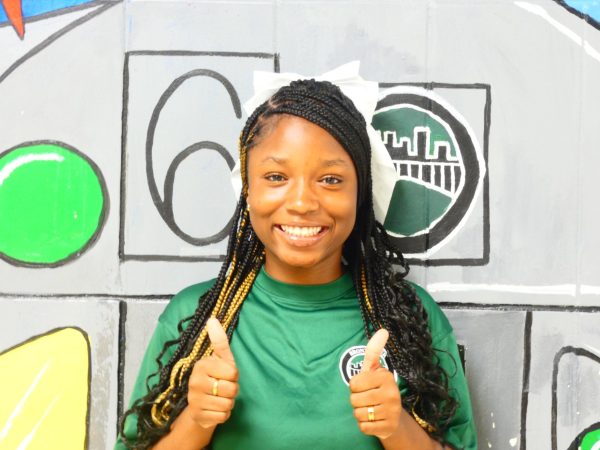
Lathania Williams, who won an investigative journalism award for her story, “ICE Crackdown Threatens Students, Neighborhoods,” felt really grateful and a little shocked at the same time. She said the award made her feel like her voice actually mattered and that the story she told had real impact.
Lathania finds inspiration through what she sees in her community and the conversations around her. ”Immigration isn’t just something in the news,”’ she said. “It’s something people around me actually experience, and I wanted to show that reality,”
Lathania hopes people understand that immigration is not just political, it’s personal. It affects real people, especially the younger generation, and it deserves to be taken seriously, she said.